
6 Sensational Spring Library Centers
Looking for engaging spring library centers? Read on to learn about six stations you can set up right away to delight your students and connect them with good books.
One of my favorite parts of being a school librarian is the moment a child stops in the doorway, eyes wide, because something unexpected is waiting for them. This week, our library is full of those moments. Here’s a peek at what’s going on at our learning centers and the thinking behind them.
The Monarch Butterfly Chrysalis
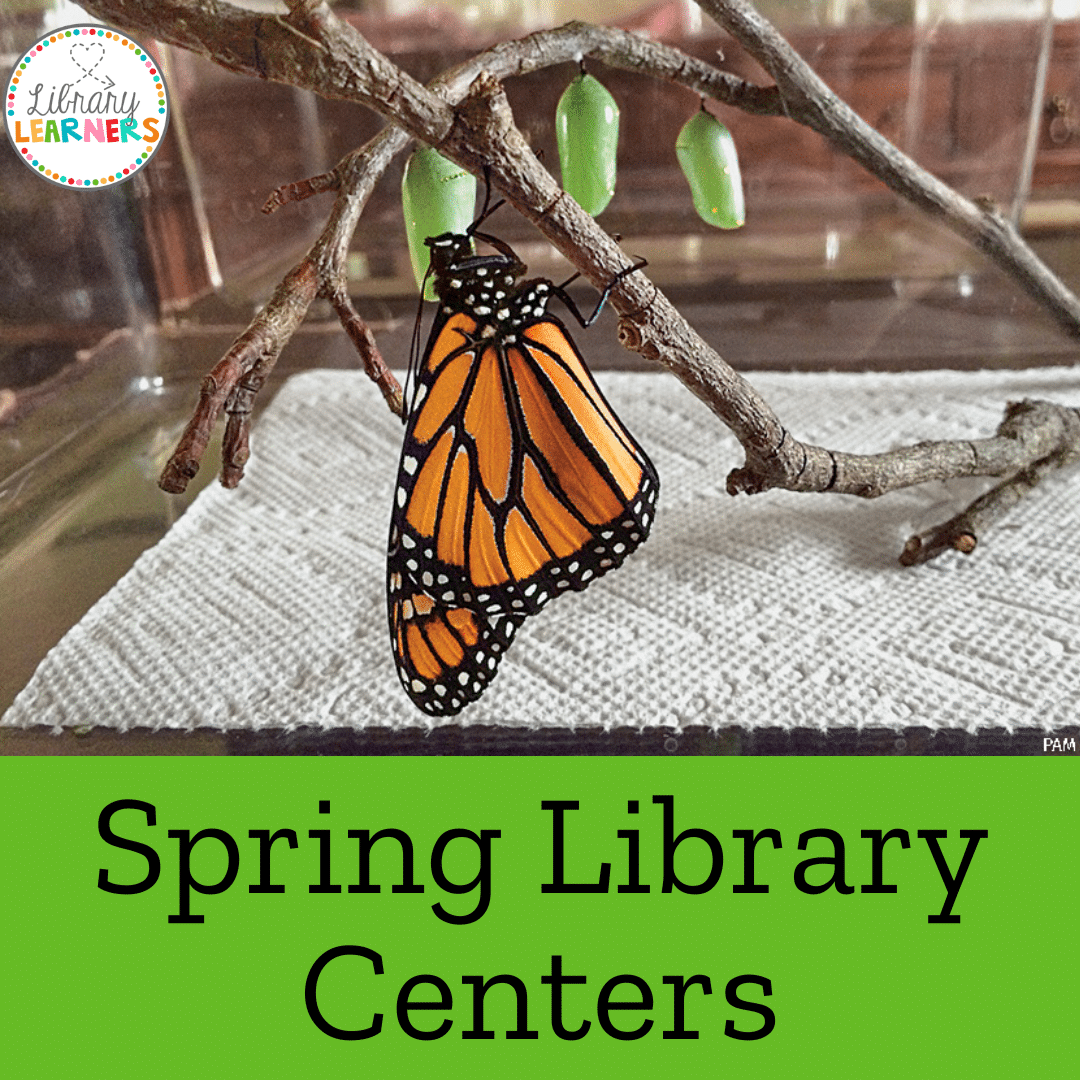
Right now, tucked inside a mesh net container on one of our tables, a Monarch butterfly chrysalis is doing its quiet, miraculous work. Students can pull up a stool, grab a magnifying glass, and just look. Displayed alongside it are books on butterflies and caterpillars — field guides, picture books, nonfiction readers across different levels — so that the wonder students feel in the moment has somewhere to go. That’s really the whole idea: let the living thing do the inviting, and let the books do the rest.
I ordered a butterfly habitat kit online, then sent in a voucher for 5 caterpillars. We have milkweed in our school garden, so I added that to the habitat to feed the growing caterpillars. Most of the observation happens during the chrysalis stage, as the butterfly emerges very quickly and not always during the school day.
The Leopard Frog

We have a new resident this week! A kindergarten teacher found herself a little tired of the feeding schedule, so her leopard frog has taken up temporary residence in the library. He’s settled into his tank on a center table, surrounded by — you guessed it — frog books. Students are already crowding around with magnifying glasses, studying the way he breathes, the texture of his skin, the stillness before a leap. There is something about a live animal that no worksheet or video can replicate. He is doing more for frog literacy this week than I ever could alone.
A frog center can also be set up with locally sourced tadpoles that you return to their native habitat after they’ve been observed for a few weeks.
The Poetry Listening Center

April is National Poetry Month, and we are celebrating! This week’s listening center features the CD recording of Jack Prelutsky’s The New Kid on the Block — one of the funniest, most kid-friendly poetry collections ever written. Students put on headphones and listen along as Prelutsky himself reads poems about Homework! Oh, Homework!, the Creature in the Classroom, and all manner of delightful nonsense. Poetry heard aloud lands differently than poetry read silently, and this recording is a wonderful reminder of that. If even one student walks away wanting to find the book and read more, the center has done its job.
I can keep this spring library center out all month and simply change the poetry CD and book that I feature each week. What? You don’t have a closet full of “old” technology like CD players and CDs? Instead, you can use tablets and the Epic reading app (free during school hours) to allow students to listen to poetry.
Whisper Read to Self Center
We also have our Whisper Read to Self Center running this week It’s a quieter, more independent station that I’ve written about in more detail in this post. It’s a wonderful complement to the more sensory, interactive spring library centers.

Spring Directed Drawing Bookmarks Center
Our elementary school does not have an art class, and of course the classroom teachers rarely have time for art projects. So I like to include a spring library center where students can learn to draw bunnies and chicks and butterflies, then use that drawing as a bookmark. Prep couldn’t be easier; just copy the pages, chop them apart, and add a bucket of pencils and crayons. This is another station that can stay out all month. Students can choose a different bookmark to draw on each visit.
Spring Puzzle Center
I’ve written a longer blog post about puzzle centers here, including my center sign and my rules (mainly that the puzzle stays out until it’s finished). An I Spy puzzle, a bugs and butterflies puzzle, or a frog puzzle are great choices for a spring library center. This is a great station to help students learn to work together on a low-stakes learning activity.
Spring Library Centers: The Bigger Picture
Every time I set up a center, my goal is the same: use the exciting object on the table — whether it’s a chrysalis, a frog, a recording, or a puzzle — to create a bridge between a child and a book they might never have picked up on their own. I always encourage students to check out the books displayed at each center. The best outcome isn’t just that they touched the magnifying glass or listened to a poem. It’s that they walked out the door with a book under their arm and a reason to open it.


I love your posts. I am inspired to be a better librarian through you.
Librarian4, I am humbled and encouraged by your comment. Thanks so much!
Cari,
How do you make sure that you still have books for that center by the end of the week if students are checking the books from the centers out? I totally agree with you about wanting them to get something that they are interested but I will run out of books by the end of the week.
I put out LOTS of books…fiction, non-fiction, poetry. I haven’t run out yet, but if I did, I would put somewhat-related books on the table. For example, if I had a frog at the center, and all the frog books were checked out, I would display books about lizards, toads, and other similar animals.
Thanks for asking, Anonymous! I’m going to write a blog post tomorrow about my tadpole center, and I’ll explain this in my post, since others may have that same question.